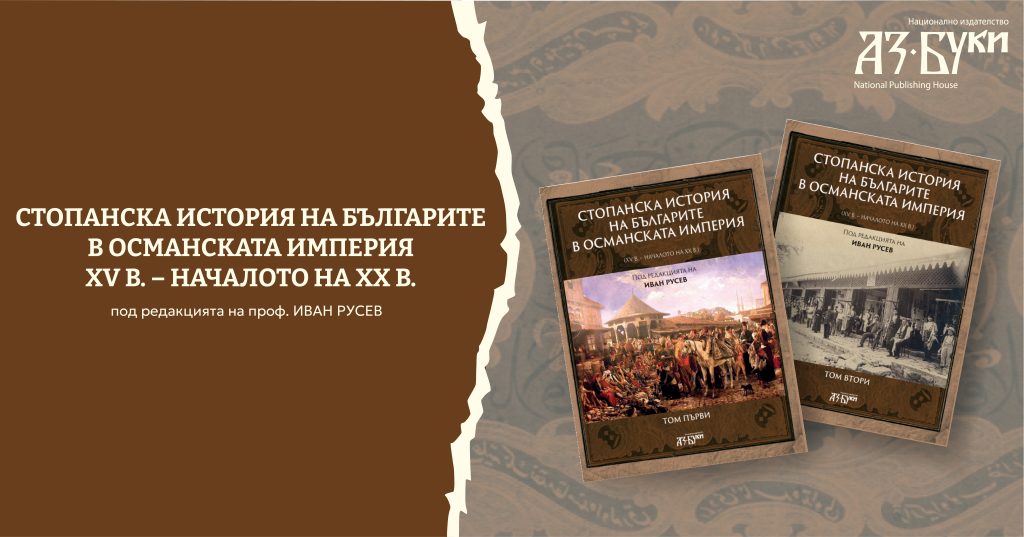
Az-buki National Publishing House presents the two-volume monograph "Economic History of the Bulgarians in the Ottoman Empire (15th Century – Early 20th Century)".
It is not difficult to explain why history is a science of traditions. Traditions are linked to the continuing efforts of historians to build on the research of their predecessors, and to the desire of each new generation of readers to seek and discover their own explanations for past processes and events. To a large extent, the subject of the present book, devoted to the economic history of the Bulgarians in the Ottoman Empire (15th – early 20th centuries), confirms such a finding. Interest in economic history, and in particular in the history of a people, always intrigues, excites and provokes, because in addition to providing knowledge about the past, it also suggests explanations for today. To present the economic development over several centuries, which took place in the conditions of the emergence, flowering and decline of a great empire and in the transition from the Middle Ages to the Modern Age, is a very complex and responsible task, which can be realised after serious, time-consuming work by a well-prepared research team. This was the starting point and the aim of the project, the final result of which is now before the eyes of the large reading public.
Several important clarifications should be made at the outset.
Throughout the existence of the Ottoman state, which lasted more than five centuries, more than 80 peoples lived and coexisted for longer or shorter periods of time. Bulgarians are one of these peoples. Economic activity, more than any other in human existence, involves communication between small and large communities, between towns and regions, and in modern times economic contacts have become increasingly global in character. Therefore, the subject of this book – the economic development of the Bulgarians in the Ottoman Empire – cannot and should not be seen as something isolated. On the contrary, it can be more fully explained if placed in a pan-imperial and regional context, an approach that the authors in this book have sought to pursue.
The two volumes of the collective monograph contain 26 chapters written by 27 authors – young and established scholars, each of them a proven specialist in his scientific field, representatives of universities, scientific institutes and museums from Bulgaria and Turkey. The general editing of the book does not necessarily mean the unification of the individual chapters. On the contrary, the authors have had complete freedom in the use of terms and in the expression of those that remain controversial in the scientific literature to this day. The careful reader is likely to find duplication of themes in individual chapters. Different opinions on the same issues may even be encountered. This is a scientific pluralism that is quite consciously sought and tolerated in the general editing of the book. The aim is to present the widest possible range of documentary information that will satisfy the interests of the most discerning reader and guide him to the right historical explanations.
Some of the chapters are accompanied by detailed appendices containing original documents, also presented in translation. There is also no shortage of illustrative material - facsimiles of documents, lithographs, photographs, etc. – to illustrate the rich content.
The monograph is edited according to all the requirements for a modern scientific publication. The individual chapters have been peer-reviewed by internationally renowned specialists.
This is the first attempt in Bulgarian historiography to present the economic history of the Bulgarians in the Ottoman Empire (15th – early 20th centuries). The book does not claim to cover the subject thoroughly (this is hardly achievable!), but I very much hope that it will serve in the future for further similar attempts to build on our efforts.
24 May 2025.,
Day of
Bulgarian Literacy
and Culture
Professor Ivan Roussev, DSc. Corresponding Member of the Bulgarian Academy of Sciences
This publication was realised with the support of the project BG-RRP-2.005-0001, TWIN4ECO, financed by the European Union – NextGeneration EU, executed by the Economic Faculty of Sofia University.
The publication is realised through the financial support of the Evlogi and Hristo Georgievi Foundation, as well as patriotic donors from Karlovo – the Tuchevi family, Valentin Mateev and Stanislav Bogoev.
COMPILER AND EDITOR:
Ivan ROUSSEV, Professor, DSc., Corresponding Member of the Bulgarian Academy of Sciences, Sofia, Bulgaria; University of Economics – Varna, Bulgaria
Authors:
Ayşe KAYAPINAR, Aldzhan DZHAFER, Anton SVRAKOV, Valentin KITANOV, Gergana GEORGIEVA, Delyan RUSEV, Ivaylo NAYDENOV, Ivan ROUSSEV, Krasimir KRASTEV, Krassimira MUTAFOVA, Krustyo YORDANOV, Levent KAYAPINAR, Miyryam SALIM, Milena PETKOVA, Nevena NEDELCHEVA, Nevyan MITEV, Nikolay TODOROV, Paulina ANDONOVA, Pencho D. PENCHEV, Petko St. PETKOV, Petar DOBREV, Petya NEDELEVA, Svetla ATANASOVA, Stefan DIMITROV, Hristiyan ATANASOV, Hristo HRISTOZOV, Yura KONSTANTINOVA
Reviewers:
Prof. Maria TODOROVA – University of Illinois at Urbana-Champaign (USA)
Prof. Nikolay NENOVSKY – CRIISEA, University of Picardie Jules Verne, Amiens
(France), University of National and World Economics, Sofia (Bulgaria)
Prof. DSc Milko PALANGURSKI – Institute for Historical Studies – BAS, Sofia
(Bulgaria)
Prof. Zhenya Zhekova – Regional Historical Museum of Shumen – Shumen (Bulgaria)
Assoc. Prof. Margarita Marinova, PhD – International Business School – Botevgrad (Bulgaria)
Editor: Savina KIRILOVA, PhD – Sofia University "St. Kliment Ohridski" (Bulgaria)
Corrector:: Aneliya Vracheva
Layout Design and Prepress: Rosen Yordanov
ISBN: 978-619-7667-80-6
978-619-7667-81-3